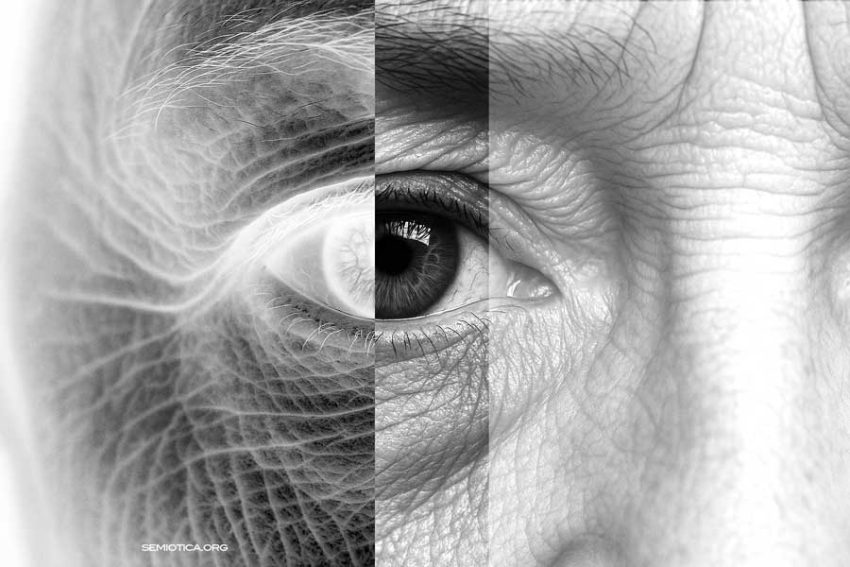
In the semiotics of orality, the body is not a secondary support for meaning but the very material of enunciation. Patrizia Violi observes that in oral discourse “sense is literally embodied, since the body constitutes the material of expression of this semiotics.” The body thus establishes the plane of expression in the same way that textual substance…
Tag: Enunciation
Semiotics of Orality: Sense in Action, Body and Voice in Enunciation
Patrizia Violi proposes to consider a specific form of the arts du faire: the art du dire. According to her, semiotics has long neglected this form of meaning production: its textualist tradition has led it to privilege the analysis of already textualized products rather than the practices that generate meaning. The discipline, in other words, has focused…
Umberto Eco: The Subject as Semiosis in Act
After the publication of Il nome della rosa, Umberto Eco replied to a journalist who asked where the author’s subjectivity could be found in the novel by saying that “the subject is in the adverbs.” What might have sounded like a witty remark was later interpreted by Patrizia Violi as an effective synthesis of an entire…
What Is a Sign? Expression, Enunciation, and Proto-signs
According to Per Aage Brandt, a sign is an act or artifact performed by an agent—human or animal—addressed to other agents with the purpose of showing, telling, or signifying something. This very article, he notes, qualifies as a sign. As such, every sign is inherently deictic: it contains an enunciative component, meaning that it points—through its…